Waste Collection Is a Data Problem: From Sensor to Route
Green Connect Solutions Team • • 3 min read
Most waste collection still runs on a fixed schedule. A truck visits every bin on its route on set days, whether the bin is overflowing or nearly empty. The schedule is easy to plan and easy to staff, but it rests on guesses about how fast each bin fills, and those guesses are wrong in both directions every week.
The alternative is to treat collection as a data problem. If you know how full each bin is, you can decide which bins need a visit today and plan an efficient route between them. Getting there takes four pieces working together: a sensor in the bin, a network to carry its readings, a platform that turns readings into decisions, and a route a driver can actually follow.
The sensor: measuring fill level
A fill-level sensor mounts under the lid or inside the top of a bin and measures the distance to the surface of the waste. From that distance and the bin's dimensions, the platform calculates how full the bin is. Readings are taken several times a day, so the data shows not only the current level but how quickly each bin fills.
Two measurement methods cover most cases. Ultrasonic sensors handle most waste types in bins and containers of many sizes. Radar sensors can measure through plastic walls and screens, which suits enclosed containers and hazardous waste that should not be touched. Both run on long-life replaceable batteries, so the practical questions during rollout are mounting, calibration, and which network each sensor will use.
The network: getting readings off the street
Bins sit in parks, alleys, basements, and industrial yards, usually far from any Wi-Fi. Fill-level sensors therefore use low-power IoT networks built for small, infrequent messages:
- LoRaWAN, which can run on a public network or on gateways you own, and suits campuses and sites where you control the coverage.
- NB-IoT and LTE-M (CAT-M1), which use mobile operator infrastructure and work well where cellular coverage is already strong, including some indoor and below-ground locations.
- Sigfox, a low-power wide-area option where it is available in your region.
The right choice depends on where your bins are, what coverage exists there, and whether you would rather own the network or pay per device. A short coverage check at representative sites, especially underground or enclosed containers, avoids surprises later.
The platform: from readings to decisions
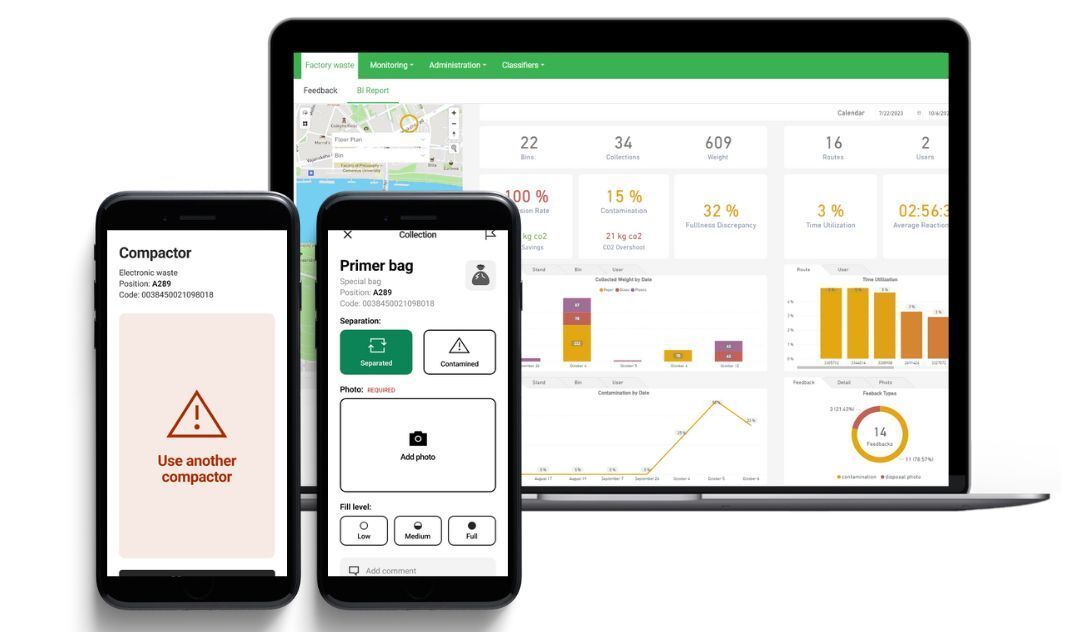
Raw readings are not useful to a dispatcher. The monitoring platform collects data from every sensor, shows each bin on a map with its current fill level, and flags the bins that will need emptying before the next planned visit. Because it keeps a history for each bin, it also shows which locations fill quickly, which bins are oversized for their use, and which are rarely more than half full.
Alerts matter as much as dashboards. A bin that fills unusually fast, a sensor reporting a tilt, or a reading that stops arriving should reach the right person without anyone having to watch a screen all day.
The route: fewer wasted trips
Route optimization closes the loop. Instead of visiting every bin, the platform builds routes that include only the bins that need service, ordered to reduce distance and drive time, and sends them to drivers through a mobile app. The operational effects are direct: fewer trips to empty bins, fewer overflows and the complaints that come with them, and better use of trucks and crews. Lower fuel use and emissions follow as a side benefit.
Some sites need control as well as visibility. Remote digital access control fits battery-powered locks to bins so that only authorized users can open them. That helps with shared residential bins, pay-as-you-throw schemes, and containers that attract illegal dumping or theft, and the access data tells collectors who is using which bin.
A pilot on a representative set of bins, run alongside the current schedule, is the sensible first step. Green Connect Solutions handles the full chain for that pilot and beyond: our team selects and fits fill-level sensors from our hardware partner Sensoneo, confirms network coverage, configures the monitoring platform and routing, and connects it all to the way your crews already work.